A recipe can tell youwhat to do.It cannot always tell you what the food needs.
Learn to taste, think, and respond to the food in front of you.
Most of us learn to cook by following instructions.
Measure this.
Heat that.
Cook it this long.
Add this much.
And most of the time, it works.
Until it doesn’t.
The timer goes off.
You followed the recipe.
You measured everything.
You did exactly what it said.
But something is still missing.
Now what?
The recipe has taken you as far as it can.
Do you add…
Salt?
Acid?
Fat?
Heat?
Do you add anything at all?
How do you know what the food actually needs?
When you taste it.
You have to ask
What am I actually experiencing?
At first, all of that feels like one thing.
But once you start separating what you’re experiencing...
you begin to see what is actually happening.
Palate
Aroma
Transformation
Transformation connects to Palate and Aroma.Good cooking begins when you stop asking, “What does the recipe say?” and start asking, “What does the food need?”
Once you start to see the connections, then you start to understand what choices to make.
The Master Flavor Map gives you a way to explore those relationships.
THE MASTER FLAVOR MAP
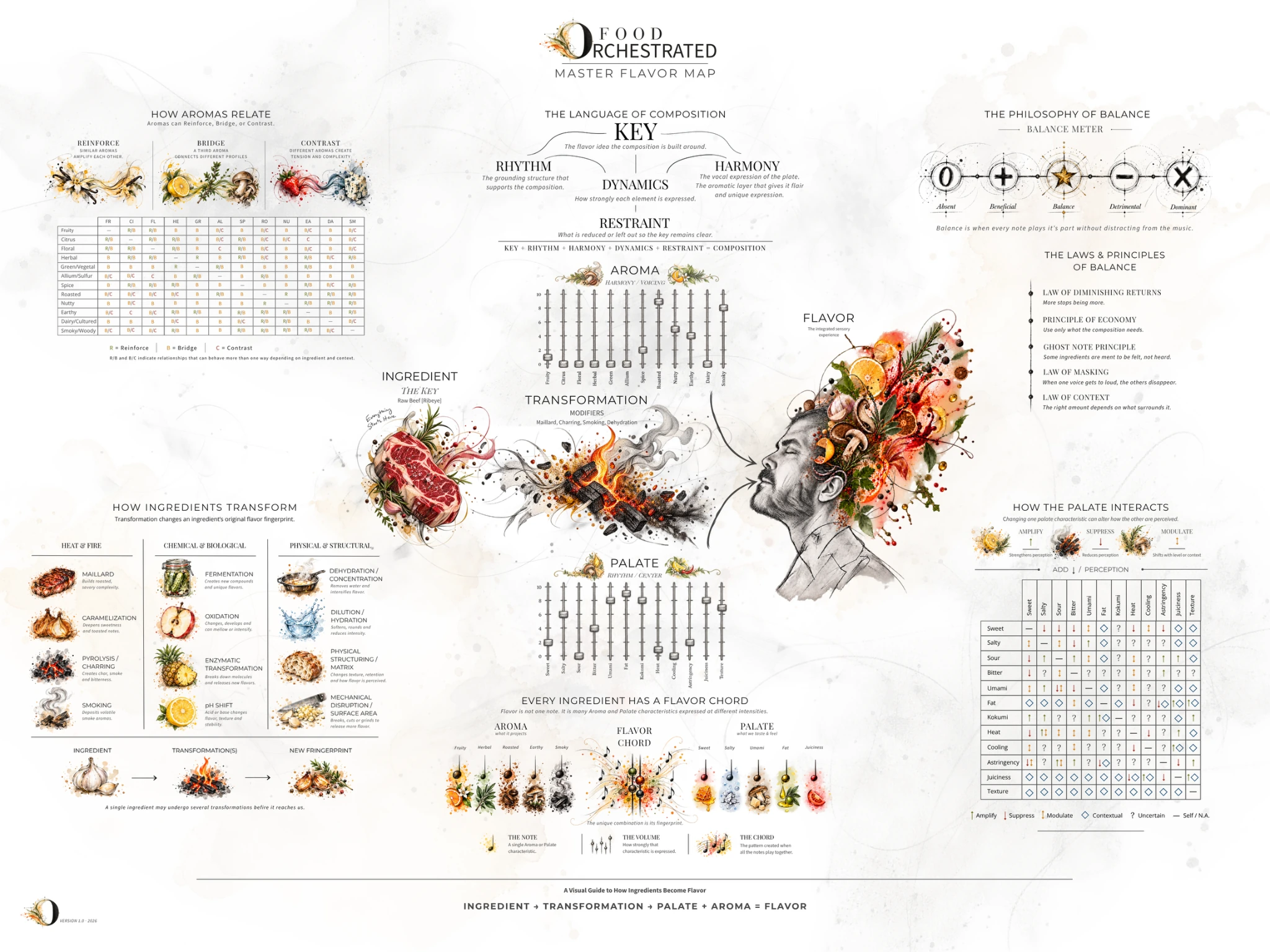
48 x 36 inches
A reference for learning to taste, think and respond.
GET THE MASTER FLAVOR MAP — FREEWelcome to Food Orchestrated.
THE MASTER FLAVOR MAP
The Master Flavor Map gives you a way to explore those relationships.
A reference for learning to taste, think and respond.
GET THE MASTER FLAVOR MAP — FREE